Industry and practical work
Quantitative finance and market systems
Notes connecting complex-systems thinking with market behaviour, quantitative research, portfolio construction and risk control.
 PDF · 17 pages
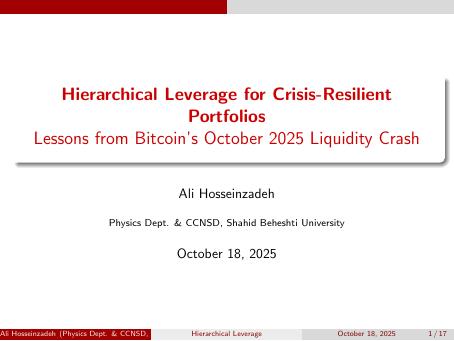
Hierarchical Leverage for Crisis-Resilient Portfolios
A risk-first framework motivated by Bitcoin’s October 2025 liquidity shock.
The note compares exponential, power-law and maximum-entropy allocations across leverage layers. A volatility-sensitive crash governor removes the highest leverage tiers as conditions deteriorate, while a risk budget constrains total exposure.
- Nonlinear allocation places progressively less capital in high-leverage layers.
- Maximum-entropy weights target exposure without concentrating the portfolio.
- Volatility regimes connect portfolio structure to live risk controls.
 PDF · 13 pages
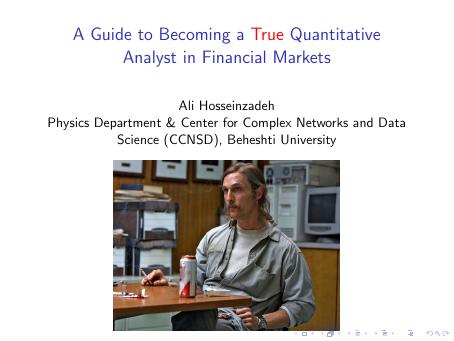
A Guide to Becoming a True Quantitative Analyst
Why good quantitative work begins with problem formulation rather than a catalogue of tools.
The guide frames quantitative analysis as an investigative process: define the problem, identify its governing principles, visualize the system, simplify it and then design tests. It surveys core skills in mathematics, programming, financial modelling, backtesting and risk management.
- Think in mechanisms, variables and falsifiable assumptions.
- Use backtests and live evidence as feedback, not as marketing.
- Combine market knowledge with statistics, computation and risk discipline.
 PDF · 18 pages
If Price Changes Are Random, How Do Quantitative Firms Make Profits?
A concise discussion of information, noise traders, price efficiency and risk-return trade-offs.
The presentation introduces informed and noise traders, Samuelson’s argument for unpredictable anticipated prices and the way intelligent trading can remove visible opportunities. It then distinguishes broad market unpredictability from temporary anomalies that may be studied across different time scales.
- Noise trading supplies liquidity and counterparties.
- Acting on information changes the price and erodes the opportunity.
- Expected return cannot be discussed independently of risk.
 PDF · 22 pages
From Econophysics to Quant
A map of how physics-trained problem solving enters quantitative finance and industrial analysis.
The presentation surveys quantitative research, algorithmic trading, simulation, risk management and backtesting, alongside researchers and organizations that connect academia with systematic finance. Its broader message is that mathematical modelling can also support decisions in banking, supply chains, energy and other complex industries.
- Quantitative work is research-based and model-driven.
- Physics contributes abstraction, simulation and multi-scale reasoning.
- The same methods can support finance and wider industrial risk analysis.
Interdisciplinary public notes
Physics perspectives on artificial intelligence
Exploratory public writing at the boundary of statistical mechanics, complexity and machine learning. These notes remain separate from the academic publication record.
 PDF · 6 pages
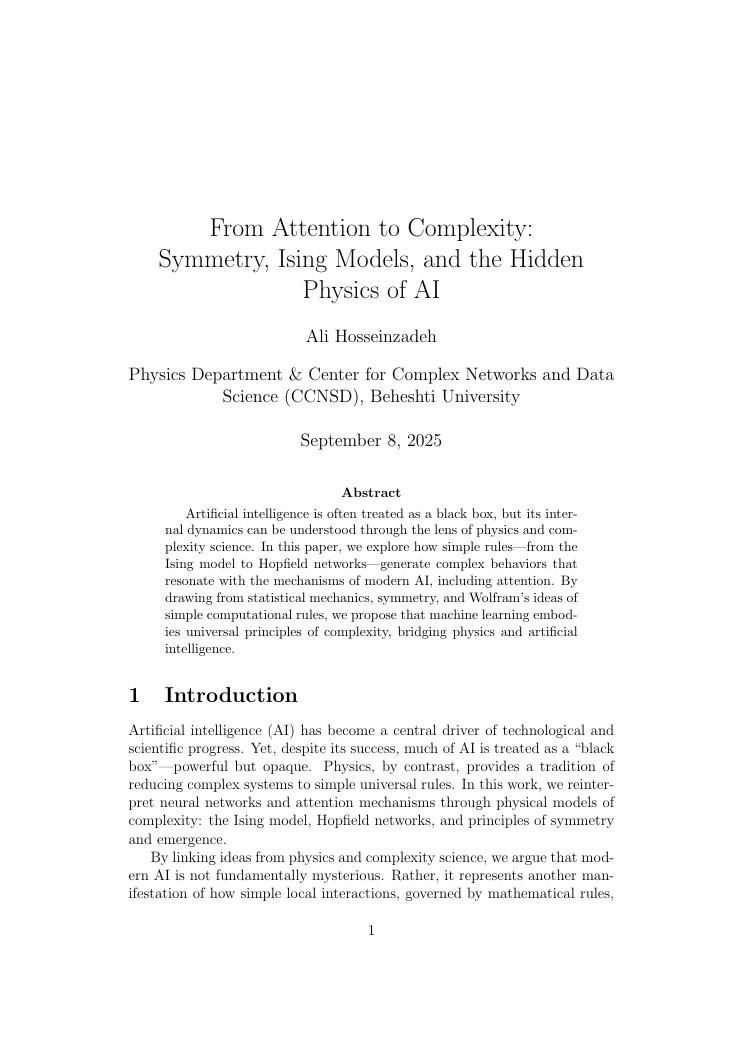
From Attention to Complexity
Symmetry, Ising models and the hidden physics of AI.
This note traces a conceptual line from the Ising model and Hopfield networks to transformer attention. The central analogy is that fixed physical couplings and dynamically computed attention weights can both produce global organization from local interactions.
- Energy landscapes connect statistical mechanics and associative memory.
- Symmetry breaking and simple iterative rules generate emergent structure.
- Attention can be viewed as context-dependent coupling between units.
 PDF · 10 pages
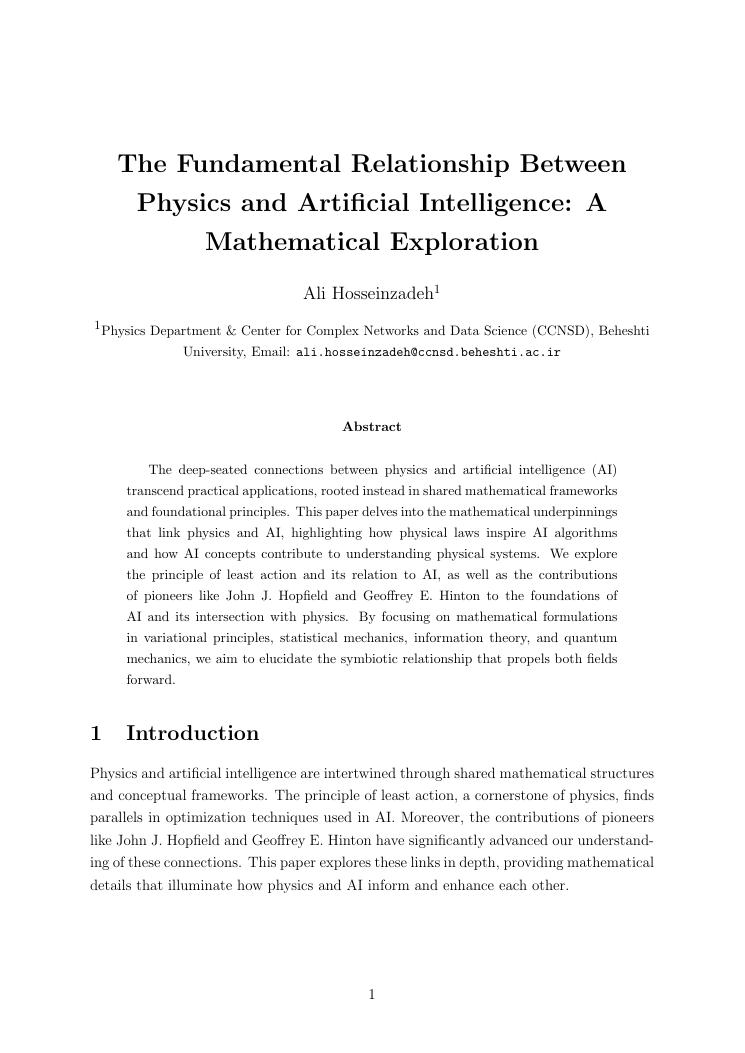
The Fundamental Relationship Between Physics and Artificial Intelligence
A mathematical tour through variational principles, statistical mechanics, information theory and learning.
The note compares least-action principles with optimization, energy-based physical models with neural networks, entropy with information measures and dynamical stability with learning behaviour. It also introduces symmetry, equivariance and physics-informed computation.
- Variational methods provide a shared language for physics and learning.
- Boltzmann and Hopfield models connect energy with computation.
- Symmetry-aware models can improve structure and generalization.
Ongoing writing
Follow new public notes
New industry-facing and interdisciplinary posts appear first on LinkedIn. Formal academic drafts and research outputs will be added to a separate academic section when ready.